Key findings
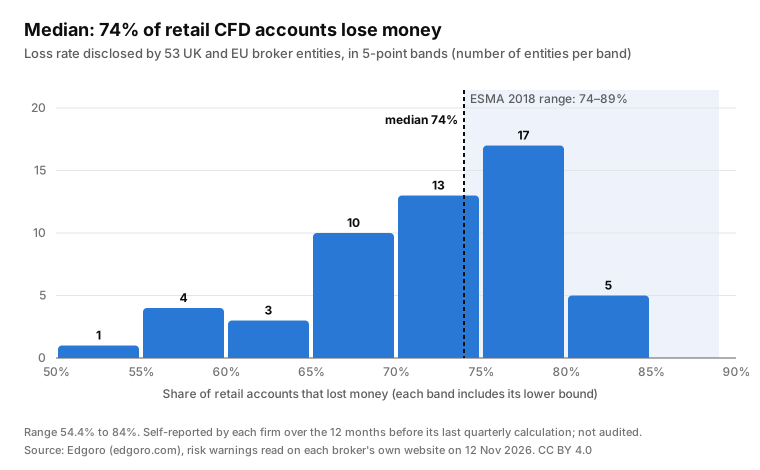
- Median 74%, mean 71.7%. Across 53 UK and EU broker entities (38 brands), the disclosed share of retail CFD accounts that lost money ranged from 54.4% (Swissquote Capital Markets Ltd, CySEC) to 84% (Indication Investments Ltd, trading as Libertex, CySEC).
- 35 of 53 entities disclosed 70% or more; 5 disclosed less than 60%.
- 26 of 53 were below 74%, the bottom of the 74–89% range of losing accounts that ESMA cited in 2018 from national regulators' studies, most of them made before leverage limits applied.
- FCA-regulated entities: median 69.5% (22). CySEC-regulated: median 75.5% (18). The groups serve different clients and products, so the gap describes the sample, not the regulators.
- The same brand can publish different figures for each entity. Plus500: 76% (UK), 80% (Cyprus), 82% (Estonia). Swissquote: 76.92% (UK), 54.4% (Cyprus). Pepperstone: 73.6%, 74.1% and 76.1%.
- No figure in Australia. None of the five Australian sites we checked (IG, CMC Markets, Pepperstone, Capital.com, OANDA) published a percentage: the ESMA and FCA rules don't apply there.
All 53 entities
Highest share first. Each sentence links to the broker's page where we read it on November 12, 2026; hover a regulator for its full name. The same table is in the CSV file.
| Broker and legal entity | Regulator | Accounts losing money | Sentence on the broker's site | Checked |
|---|---|---|---|---|
| LibertexIndication Investments Ltd | CySEC | 84% | “84% of retail investor accounts lose money when trading CFDs with this provider.” The visible risk warning says 84%; a second, hidden copy of the warning on the same page says 79%. | |
| iFOREXiCFD Limited | CySEC | 83% | “83% of retail investor accounts lose money when trading CFDs with this provider.” | |
| Plus500Plus500EE AS | EFSA | 82% | “82% of retail investor accounts lose money when trading CFDs with this provider.” Read on Plus500's Irish page, which marks the Estonian regulator as the one applicable to the visitor. | |
| Markets.comSafecap Investments Limited | CySEC | 81.9% | “81.9% of retail investor accounts lose money when trading CFDs with this provider.” | |
| Plus500Plus500CY Ltd | CySEC | 80% | “80% of retail investor accounts lose money when trading CFDs with this provider.” | |
| XTBXTB S.A. | KNF | 79% | “79% der Kleinanlegerkonten verlieren Geld beim CFD-Handel mit diesem Anbieter.” (German) German branch of XTB S.A. The French branch page (xtb.com/fr) showed the same 79%. | |
| GO MarketsGO Markets Ltd | CySEC | 78% | “78% of retail investor accounts lose money when trading CFDs with GO Markets Ltd.” | |
| XTBXTB Limited | FCA | 78% | “78% of retail investor accounts lose money when trading CFDs with this provider.” | |
| EightcapEightcap EU Ltd | CySEC | 77.97% | “77.97% of retail investor accounts lose money when trading CFDs with Eightcap EU Ltd.” The rendered page shows 77.97% twice; the server HTML of the same page still carried 71.28% in its footer. | |
| OANDAOANDA TMS Brokers S.A. | KNF | 77% | “77% of retail investor accounts lose money when trading CFDs with this provider.” The page's code also says '77% of retail investor accounts lose money when trading CFDs with OANDA TMS Brokers S.A.' | |
| Trading 212Trading 212 Markets Ltd | CySEC | 77% | “77% of retail investor accounts lose money when trading CFDs with this provider.” Read in the site's per-entity warning text (key 'cfd-warning-cy') in the page's code. | |
| SwissquoteSwissquote Ltd | FCA | 76.92% | “76.92% of retail investor accounts lose money when trading CFDs with this provider.” | |
| OANDAOANDA Europe Limited | FCA | 76.6% | “76.6% of retail investor accounts lose money when trading CFDs with this provider.” | |
| XMTrading Point of Financial Instruments Limited | CySEC | 76.15% | “76.15% of retail investor accounts lose money when trading CFDs with this provider.” Read in the server HTML; the page did not finish loading in our browser. | |
| PepperstonePepperstone GmbH | BaFin | 76.1% | “76.1% der Kleinanlegerkonten verlieren Geld beim CFD-Handel mit diesem Anbieter.” (German) One product disclaimer in the same page's code says 73,9 %; the visible risk warning says 76.1%. | |
| AdmiralsAdmirals Europe Ltd | CySEC | 76% | “76% of retail investor accounts lose money when trading CFDs with this provider.” | |
| Plus500Plus500UK Ltd | FCA | 76% | “76% of retail investor accounts lose money when trading CFDs with this provider.” | |
| Trading 212Trading 212 EU GmbH | BaFin | 76% | “76% of retail investor accounts lose money when trading CFDs with this provider.” Read in the site's per-entity warning text (key 'cfd-warning-de') in the page's code; the French CFD page (trading212.com/fr/cfd) displayed the same 76 %. | |
| Trade NationTrade Nation Europe Empresa de Investimento, S.A. | CMVM | 75.8% | “75,8% of retail investor accounts lose money when trading CFDs.” The sentence omits 'with this provider'; a cookie-banner text in the page's code uses the generic 'Between 74–89%' wording. | |
| NAGANAGA Markets Europe Ltd | CySEC | 75.04% | “75.04% of retail investor accounts lose money when trading CFDs with this provider.” The rendered page shows 75.04%; the server HTML of the same page also carried 77.41% and 87.36% in other blocks. | |
| FxProFxPro UK Limited | FCA | 75% | “75% of retail investor accounts lose money when trading CFDs and Spread Betting with this provider.” fxpro.co.uk redirected to fxpro.com, which showed the UK entity's warning and footer. | |
| Trading 212Trading 212 UK Ltd | FCA | 75% | “75% of retail investor accounts lose money when trading CFDs with this provider.” Read in the site's per-entity warning text (key 'cfd-warning-uk') in the page's code; the site redirected us to its French version, which does not display the UK warning. | |
| FP MarketsFirst Prudential Markets Ltd | CySEC | 74.51% | “74.51% of retail CFD accounts lose money.” Short form of the warning; the page's footer gives the same 74.51% in the full sentence. | |
| PepperstonePepperstone EU Limited | CySEC | 74.1% | “74.1% of retail investor accounts lose money when trading CFDs with this provider.” | |
| FOREX.comStoneX Financial Ltd | FCA | 74% | “74% of retail investor accounts lose money when trading CFDs with this provider.” Same legal entity as StoneX Trading, which shows its own figure (68%). | |
| IGIG Europe GmbH | BaFin | 74% | “74 % der Kleinanlegerkonten verlieren Geld beim CFD-Handel mit diesem Anbieter.” (German) IG's Italian page (ig.com/it), also IG Europe GmbH, showed the same 74%. | |
| TickmillTickmill Europe Ltd | CySEC | 74% | “74% of retail investor accounts lose money when trading CFDs with Tickmill Europe Ltd.” | |
| PepperstonePepperstone Limited | FCA | 73.6% | “73.6% of retail investor accounts lose money when trading spread bets and CFDs with this provider.” | |
| IC MarketsIC Markets (EU) Ltd | CySEC | 73.46% | “73.46% of retail investor accounts lose money when trading CFDs with IC Markets (EU) Ltd.” | |
| Capital.comCapital Com SV Investments Limited | CySEC | 73% | “73% of retail investor accounts lose money when trading CFDs with this provider.” The same page also shows the generic 'Between 74-89%' warning for Capital Com Group Ltd, a non-EU group entity. | |
| VantageVantage Global Prime LLP | FCA | 72.65% | “72.65% of retail investor accounts lose money when trading CFDs and Spread Bets with this provider.” | |
| DukascopyDukascopy Europe IBS AS | Latvijas Banka | 70.39% | “70.39% of retail investor accounts lose money when trading CFDs with this provider.” The page names the entity and its Riga address; the regulator (Latvijas Banka) comes from Latvia's public register, not the page. | |
| ActivTradesActivTrades PLC | FCA | 70% | “70% of retail investor accounts lose money when trading CFDs with this provider.” The page names ActivTrades PLC and says it is the UK website; the FCA as regulator comes from the FCA register, not the page. | |
| CMC MarketsCMC Markets Germany GmbH | BaFin | 70% | “70% der Kleinanlegerkonten verlieren Geld beim Handel mit CFDs und OTC Optionen bei diesem Anbieter.” (German) The Irish page (cmcmarkets.com/en-ie), also CMC Markets Germany GmbH, showed the same 70%. | |
| IGIG Markets Ltd / IG Index Ltd | FCA | 70% | “70% of retail investor accounts lose money when trading spread bets and CFDs with this provider.” | |
| Capital.comCapital Com (UK) Limited | FCA | 69% | “69% of retail investor accounts lose money when trading spread bets and CFDs with this provider.” | |
| CMC MarketsCMC Markets UK plc | FCA | 69% | “69% of retail investor accounts lose money when spread betting and/or trading CFDs with this provider.” The visible risk warning shows 69%; a hidden copy of the warning in the same page (also in the UK homepage's code) says 68%. | |
| LCGLondon Capital Group | FCA | 69% | “69% of retail investor accounts lose money when trading spread bets and CFDs with this provider.” | |
| City Index / StoneX TradingStoneX Financial Ltd | FCA | 68% | “68% of retail investor accounts lose money when trading CFDs with this provider.” cityindex.com/en-uk/ redirected to this StoneX Trading page. | |
| TickmillTickmill UK Ltd | FCA | 68% | “68% of retail investor accounts lose money when trading CFDs with Tickmill UK Ltd.” | |
| AxiAxi Financial Services (UK) Limited | FCA | 67.7% | “67.7% of retail investor accounts lose money when trading CFDs with this provider.” | |
| FXCMStratos Markets Limited | FCA | 67% | “67% of retail investor accounts lose money when trading CFDs with this provider.” | |
| SaxoSaxo Bank A/S | Danish FSA | 66% | “66% de comptes d'investisseurs de détail perdent de l'argent lors de la négociation de CFD avec ce fournisseur.” (French) French branch of Saxo Bank A/S. Saxo's international page (home.saxo) showed the same 66% in English. | |
| RoboMarketsRoboMarkets Ltd | CySEC | 65.68% | “65.68% of retail investor accounts lose money when trading CFDs with this provider.” Read in the server HTML (twice, 11:25 and 14:02 UTC); the page did not render in our browser. | |
| SkillingSkilling Limited | CySEC | 65% | “65% of retail investor accounts lose money when trading CFDs with this provider.” | |
| SpreadexSpreadex Ltd | FCA | 64% | “64% of retail investors lose money when trading spread bets and CFDs with this provider.” The Spreadex group homepage (spreadex.com) showed 61% in its financial-trading panel and 64% in its footer; the financials page shows 64% only. | |
| SaxoSaxo Capital Markets UK Ltd | FCA | 61% | “61% of retail investor accounts lose money when trading CFDs with this provider.” | |
| FXOpenFXOpen Ltd | FCA | 60% | “60% of retail investor accounts lose money when trading CFDs with this provider.” | |
| LYNXLYNX B.V. | AFM | 59.07% | “59.07 % der Kleinanlegerkonten verlieren Geld beim CFD-Handel mit diesem Anbieter.” (German) German branch of the Dutch firm LYNX B.V.; the same page also says '59.07 % der Kleinanlegerkonten verlieren Geld beim CFD-Handel über LYNX'. | |
| Interactive BrokersInteractive Brokers (U.K.) Limited | FCA | 58.9% | “58.9% of retail investor accounts lose money when trading CFDs with IBKR.” The UK and Irish sites show the same 58.9%, worded 'with IBKR'. | |
| Interactive BrokersInteractive Brokers Ireland Limited | CBI | 58.9% | “58.9% of retail investor accounts lose money when trading CFDs with IBKR.” The UK and Irish sites show the same 58.9%, worded 'with IBKR'. | |
| DarwinexSapiens Markets EU Sociedad de Valores SA | CNMV | 55% | “55% of retail investor accounts lose money when trading CFDs with this provider.” | |
| SwissquoteSwissquote Capital Markets Ltd | CySEC | 54.4% | “54.40% of retail investor accounts lose money when trading CFDs with this provider.” |
Distribution and regulators
Most entities cluster between 65% and 80%: 40 of 53.
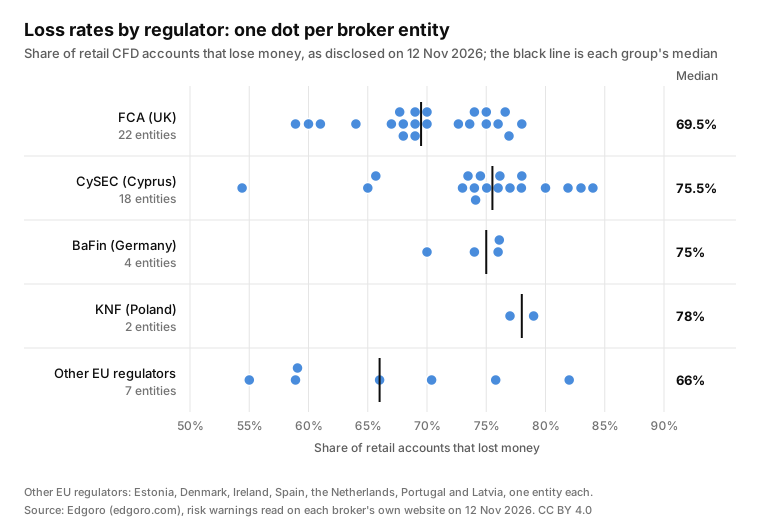
| Regulator | Entities | Median | Lowest | Highest |
|---|---|---|---|---|
| FCA (United Kingdom) | 22 | 69.5% | 58.9% | 78% |
| CySEC (Cyprus) | 18 | 75.5% | 54.4% | 84% |
| BaFin (Germany) | 4 | 75% | 70% | 76.1% |
| KNF (Poland) | 2 | 78% | 77% | 79% |
| AFM (Netherlands) | 1 | 59.1% | 59.07% | 59.07% |
| CBI (Ireland) | 1 | 58.9% | 58.9% | 58.9% |
| CMVM (Portugal) | 1 | 75.8% | 75.8% | 75.8% |
| CNMV (Spain) | 1 | 55% | 55% | 55% |
| Danish FSA (Denmark) | 1 | 66% | 66% | 66% |
| EFSA (Estonia) | 1 | 82% | 82% | 82% |
| Latvijas Banka (Latvia) | 1 | 70.4% | 70.39% | 70.39% |
Why brokers publish this figure
In 2018 the European Securities and Markets Authority restricted the sale of CFDs to retail clients across the EU (Decision (EU) 2018/796, applied from 1 August 2018): leverage limits, a margin close-out rule, negative balance protection, no trading incentives, and a standard risk warning. The warning must include “an up-to-date provider-specific loss percentage”, and the calculation “shall be performed every 3 months and cover the 12-month period preceding the date on which it is performed”. A provider that had no open retail CFD in the last 12 months uses a generic sentence instead: “Between 74-89 % of retail investor accounts lose money when trading CFDs.”
ESMA's measures were temporary and renewed every three months; between March 2019 and April 2020 national regulators replaced them with permanent rules of their own (ESMA, product intervention). In the UK the Financial Conduct Authority made the rules permanent in PS19/18 (1 July 2019, in force for CFDs from 1 August 2019), now COBS 22.5 of its Handbook. COBS 22.5.6R requires the percentage of retail client accounts that lost money, calculated “every three months” over “the 12-month period preceding the date of the calculation”. An account counts as losing if its realised and unrealised net profit on these products over the period is below zero, after all costs, fees and commissions; accounts with no open position in the period, deposits and withdrawals are left out. UK figures include spread bets where the firm offers them.
The figures are therefore updated quarterly by each firm. We check them again every quarter: the next check is in February 2027.
How we collected it
- The broker's own page only. We looked for the disclosure on about 60 broker websites serving retail clients in the UK, the EU and Australia, on their homepage or CFD page, on November 12, 2026 between 11:25 and 14:03 UTC, from a desktop browser in France. Third-party sites were used only to find where a disclosure sits, never as the source of a figure.
- One row per legal entity. Many brands run several regulated companies, each with its own figure; we recorded each one we could read separately, and identified the entity from the legal text on the same page.
- What a visitor sees. 48 figures come from the text of the rendered page, 3 (Trading 212) from the per-entity warning text in the page's code, and 2 (XM, RoboMarkets) from the page's HTML because it didn't finish loading in our browser.
- Conflicting figures are shown, not hidden. On 6 sites a second figure for the same entity also appeared that day (a hidden copy of the warning, an older string in the page's code, or another page of the site). We kept the figure of the visible risk warning and list the other in the table's notes and the CSV.
- Evidence kept. For every row we saved the URL, the exact sentence, the time it was read and the text that names the legal entity; the file is in our repository at
scripts/studies/cfd-loss-rates/raw-2026-11-12.json. - Statistics. Count, mean, median, lowest and highest across entities, unweighted: a firm with a few hundred clients counts as much as one with hundreds of thousands.
Limitations
- Self-reported, not audited. Each firm calculates its own figure under the regulator's method. The FCA's rule asks firms to keep the records behind it for five years; it doesn't ask for an independent audit.
- Different 12-month windows. Each firm recalculates every three months on its own schedule, so on the same day the figures cover 12-month periods that can end up to three months apart, and a firm may update its website later than its calculation.
- Client mix, not quality. A lower share doesn't mean a given client is more likely to profit with that firm. It depends on who the clients are, what they trade and for how long; professional clients are not counted.
- Losing, not how much. The figure counts accounts with a net loss over the period; it says nothing about the size of the losses or gains.
- A sample. These are the brokers whose figure we could read and attribute; sites can show other content in other countries, and some firms were left out (below).
Brokers left out
- eToro. Shows 55% once, in a footer that lists eToro (Europe) Ltd (CySEC), eToro (UK) Ltd (FCA), eToro AUS Capital (ASIC) and non-European entities, so the figure can't be attributed to one entity.
- AvaTrade. Shows 65% on the group site, whose footer lists AVA Trade EU Ltd (Central Bank of Ireland) alongside non-European entities, so the figure can't be attributed to one entity.
- ActivTrades (EU site). Shows 73%, but neither the page nor its regulation page named the legal entity when we read them.
- ThinkMarkets. The UK and EU pages redirected us to a French-language page run by a Seychelles entity; no UK or EU figure could be read.
- Exness (EU). exness.eu is a business-to-business page with no retail loss percentage.
- easyMarkets (EU). The page could not be loaded.
- Sites outside the UK and EU rules. IG's international site showed 80% and ActivTrades' non-European site 85%; both are outside the scope of this tracker, as are Capital.com's non-EU group entity and other firms that show ESMA's generic 74–89% sentence.
- Australia. IG, CMC Markets, Pepperstone, Capital.com, OANDA: no percentage on their Australian sites.
What this means if you build or buy an automated strategy
A bot trades the same CFDs as a person, through the same accounts, so these figures describe its starting point too. Three things decide most of the result, whoever places the orders:
- Costs compound with the number of trades. The spread, commission and overnight financing are part of the calculation above. Work out what they take from the strategy's average trade before anything else, for example with the trading fee calculator.
- Leverage multiplies losses as well as gains. The retail limits (30:1 on major currency pairs, down to 2:1) are a ceiling, not a target. Our test of 240 leveraged setups chasing +10% a day shows how quickly liquidations add up.
- Test out of sample before real money. A backtest that looks good on the data it was tuned on says little; keep a period apart and include realistic costs. The Backtest Lab does both, and our algorithmic trading statistics collect the research on how often backtested edges hold up.
A seller's backtest or a past track record is not a guarantee, and nothing on this page is investment advice.
Data and how to cite
cfd-retail-loss-rates-2026-q4.csv (53 rows: id, broker, legal entity, regulator, percentage, the exact sentence and its language, source URL, check date, other figures seen and notes). The data is free to reuse under the Creative Commons Attribution 4.0 licence: credit Edgoro and link to this page.
Edgoro, “Retail CFD loss rates by broker”, edgoro.com/research/cfd-retail-loss-rates, checked November 12, 2026. Data: edgoro.com/data/cfd-retail-loss-rates-2026-q4.csv (CC BY 4.0).
Spotted a figure that has changed, or a broker we missed? Write to us through the contact page. The tracker is checked every quarter; next check February 2027.
Trading involves substantial risk of loss and is not suitable for every investor. Edgoro is a software tool, not a broker or financial adviser: nothing it produces is investment advice, and past or backtested performance does not guarantee future results.